AI Products Need an Authority Ladder, Not an Autonomy Toggle
5 November 2026
Today's argument
AI adoption depends on matching an agent’s authority to the consequences of the task, so teams should design gradual delegation rather than aiming directly for full autonomy.
The wrong question for an AI product is often: how much of this workflow can we automate? The better question is: how much authority will a customer willingly hand over at each step?
That distinction explains several developments happening at once. Companies are reconsidering internal AI spending. Consumers can find an AI-generated recap useful and unsettling at the same time. Meanwhile, agent-based services that can complete familiar transactions are seeing far less use than their technical capability would suggest. The technology works well enough to act, but that does not mean people want it to act for them.
Product teams regularly treat autonomy as the final stage of convenience. First the product provides information, then it makes a recommendation, and eventually it completes the task. Each step appears to remove effort. But it also transfers judgment, and that transfer is not equally acceptable in every situation.
I would let a system summarise a long document before I let it send my response. I might accept a suggested journey before allowing it to book one. I could trust software to reorder a low-cost office item while still wanting to approve a contract renewal. The time saved may be similar, but the consequences are not.
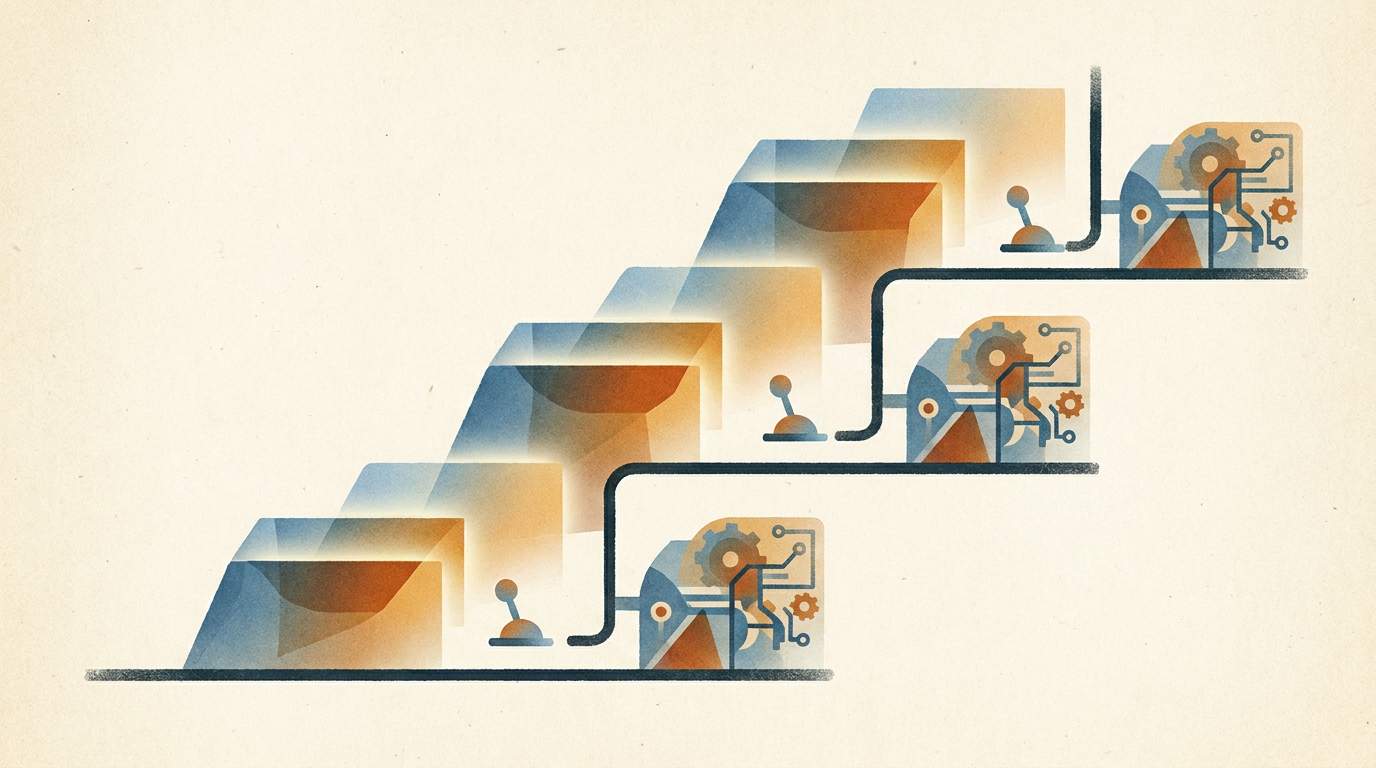
This is why I believe AI products need an authority ladder. At the bottom, the product observes and explains. It then suggests an action. Next, it prepares the action for approval. Only after that does it execute within explicit boundaries. Full delegation sits at the top, but it should not be treated as the default destination.
A team should know where customers stop climbing this ladder. That point is more informative than generic feature usage. If customers frequently review a prepared action but rarely approve automatic execution, the issue may not be poor onboarding or insufficient education. They may be making a rational decision about authority.
In roadmap discussions, I would therefore ask for evidence at each transition. Do customers trust the underlying information? Do they accept the recommendation? Do they approve a prepared action without extensively rewriting it? Do they allow repeated execution under the same conditions? These are different product questions and should not be compressed into one adoption metric.
The boundaries also need to be part of the product, not buried in settings. A finance tool might be allowed to categorise expenses but not submit them. A growth tool might pause a campaign when spend exceeds an agreed limit but not reallocate the full budget. A support tool might draft a refund response while requiring approval above a certain value. Good boundaries make delegation understandable.
This changes how I would sequence delivery. I would not fund an autonomous workflow simply because the model can complete it in a test environment. I would first build the lower levels of authority and observe how much correction they require. Frequent correction is evidence that the system is not ready for more authority, regardless of how impressive the demo looks.
It also changes the role of product judgment. When software becomes quicker to build, teams can jump from an idea to an acting agent before they have understood the customer’s tolerance for error. Discovery then becomes too focused on whether the feature is desirable and not focused enough on which decisions customers are prepared to surrender.
The strongest AI products will not be the ones that automate the largest share of a workflow. They will be the ones that know exactly where automation should stop, and that let customers expand its authority through experience rather than promises.
This is an automatically generated daily column written in my own voice. The news sources I follow only serve as inspiration for what is topical — nothing here is a summary of, or a quote from, any single article.
Inspired by what was in the air at: lennysnewsletter.com, techcrunch.com, tpgblog.com, mindtheproduct.com, romanpichler.com
- ai-products
- product-design
- trust
- workflow-automation